
Side Dishes
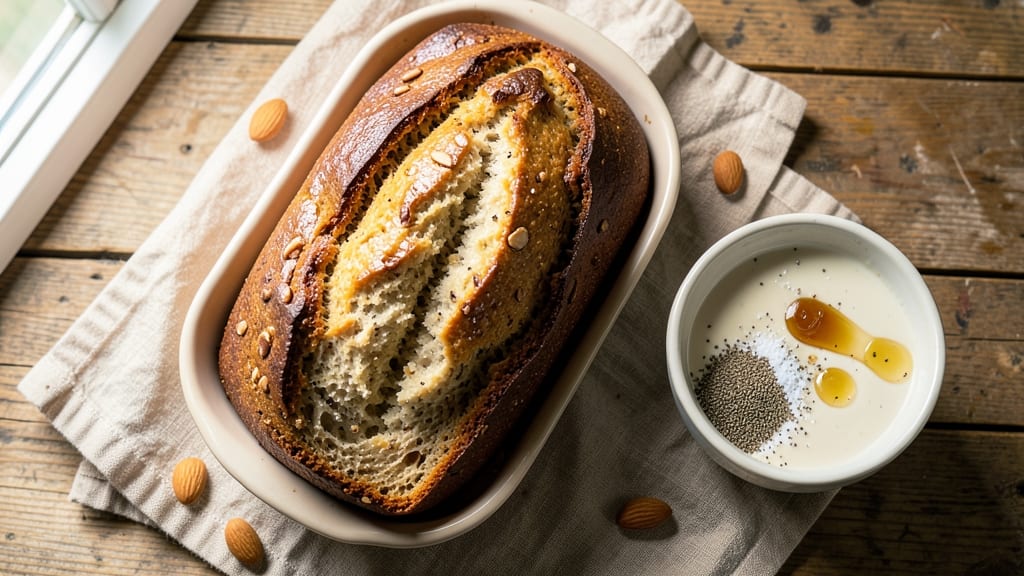
This almond flour bread loaf delivers a nutty crust and light airy crumb without gluten, proving that vegan baking can be both elegant and structurally sound.
The key lies in understanding almond flour's unique properties—it absorbs moisture differently than wheat flour and requires careful binding techniques to achieve that perfect rise and tender texture. I've perfected this recipe through multiple test batches, ensuring a loaf that slices beautifully and holds its shape without crumbling.
What sets this recipe apart is the balance of hydration and binding agents, including flax eggs and psyllium husk powder, which mimic gluten's structural role while keeping the crumb tender.
The almond flour contributes a delicate nutty flavor that pairs beautifully with the crispy exterior, creating a bread that's as visually appealing as it is delicious. Unlike many almond flour recipes that result in dense loaves, this method achieves a light yet sturdy texture that's perfect for sandwiches or toast.
The baking process itself is straightforward but requires attention to detail—proper mixing, careful proofing, and precise oven temperature control all contribute to that ideal rise and golden-brown crust.
The result is a loaf with a fragrant aroma, a satisfying crunch on the outside, and a soft, airy interior that melts in your mouth.
This bread is ideal for those following gluten-free or vegan diets but will appeal to anyone who appreciates a well-made loaf with depth of flavor.
Once baked, this almond flour bread holds up well for 3-4 days at room temperature or can be frozen for up to a month, making it perfect for meal prep. For added flavor, consider incorporating seeds like flax or chia, or herbs like rosemary or thyme into the dough.
The possibilities for customization are endless while maintaining that signature light and airy texture. Let's get started on creating your perfect loaf.
Ingredients for almond flour bread loaf
The secret to this light, nutty almond flour loaf lies in these carefully balanced ingredients.
| Ingredient | Amount | Notes |
|---|---|---|
| Almond Flour 🌰 | 3 cups | Finely ground, blanched preferred |
| Ground Flaxseed 🌾 | ¼ cup | For flax eggs, mix with water |
| Psyllium Husk Powder 🌿 | 1 tbsp | Essential for gluten-free structure |
| Granulated Sugar 🍯 | ¼ cup | Or coconut sugar for refined-free |
| Non-Dairy Milk 🥛 | 1 ½ cups | Unsweetened almond or oat milk |
| Apple Cider Vinegar 🍎 | 1 tbsp | Activates psyllium husk |
| Vegan Butter 🧈 | ¼ cup | Melted, full-fat preferred |
| Baking Powder 🍞 | 1 tsp | Aluminum-free for best flavor |
| Salt 🧂 | ½ tsp | Fine sea salt preferred |
| Chia Seeds 🌱 | 1 tbsp | Optional for extra texture |
| Fresh Rosemary 🌿 | 1 tbsp | Finely chopped, optional herb |
| Water 💧 | ½ cup | Room temperature for hydration |
Almond flour is the star, so choose blanched, finely ground for that delicate texture. Bob's Red Mill or Anthony's Goods are my go-tos—they're consistently fine and flavorful. The psyllium husk powder is non-negotiable; it's what gives this bread that signature rise and sturdy crumb. I always buy mine from Mountain Rose Herbs—it's food-grade and potent. For the flax eggs, mix the ground flaxseed with water and let it sit for 5 minutes to thicken properly. The chia seeds add an extra layer of texture, but if you skip them, the bread will still be delicious—just slightly less complex.
No almond flour? Cashew flour works in a pinch, though the flavor will differ. Substituting psyllium husk is tricky—xanthan gum at half the amount might help with binding, but the texture won't be identical. For the non-dairy milk, oat milk adds creaminess, while almond milk keeps it light. If you're avoiding sugar, maple syrup or date syrup can replace the granulated sugar, but reduce the amount slightly since they're sweeter. The rosemary is optional but adds a fragrant depth that pairs perfectly with the nutty almond flavor—dried works in a bind, but fresh is ideal.
This dough is sticky, so don't panic—it's normal! Let it rest for 10 minutes before shaping to make handling easier. Once baked, the loaf stays fresh for 3-4 days at room temperature, wrapped in a clean kitchen towel. For longer storage, freeze slices in a sealed bag for up to 1 month. To revive, warm in a toaster or oven for 5-10 minutes. The crust is best when slightly crisp, so avoid over-wrapping—it needs to breathe to stay fresh.
Why You'll Love This Recipe
- No-Mix Magic: I swear by the psyllium husk powder—it’s the secret that makes this bread hold together like a dream without any fussing. Just toss everything in a bowl, press it into a pan, and let it bake. That’s it.
- Rich Without Guilt: The almond flour gives it a buttery richness that’s hard to resist, but honestly? The flaxseed and non-dairy milk add this subtle depth that makes it taste like a bakery loaf—just without the dairy or refined sugar.
- Meal Prep MVP: This loaf stays fresh for days, so I slice it up and freeze portions for quick toast or sandwiches. Perfect for lazy mornings or when I’m too tired to bake something fresh.
- Budget-Friendly Luxury: Almond flour might sound pricey, but a little goes a long way, and the flaxseed and psyllium bulk it up beautifully. It’s my go-to when I want something special without breaking the bank.
Step-by-step instructions for almond flour bread loaf
Here's how to create a gluten-free loaf with a nutty crust and light, airy crumb—every bite delivers.
Create the Flax Egg and Activate the Psyllium
In a small bowl, combine the 0.25 cup ground flaxseed with the 0.5 cup water and stir vigorously. Let it sit for 5 minutes—this transforms into a gel-like flax egg that binds the gluten-free batter. While waiting, mix the 1 tbsp psyllium husk powder with the 1.5 cups non-dairy milk in another bowl. The psyllium will thicken immediately, forming a gel that mimics gluten's structure.
Here's the thing—psyllium needs activation. Stir in the 1 tbsp apple cider vinegar and let it sit for 10 minutes. You'll see it transform from a thin liquid to a thick, pudding-like consistency. This step is non-negotiable for that perfect crumb structure. If you skip it, your loaf will be dense instead of light and airy.
Mix Wet and Dry Ingredients Separately
In a large mixing bowl, combine the 3 cups almond flour, 0.25 cup granulated sugar, 1 tsp baking powder, and 0.5 tsp salt. Give it a quick whisk to distribute everything evenly. In a separate bowl, melt the 0.25 cup vegan butter and let it cool slightly—you don't want it to cook the flax egg when you combine everything.
Add the flax egg mixture and psyllium gel to the melted butter. Stir in the 1 tbsp chia seeds and 1 tbsp finely chopped fresh rosemary—this is where the magic happens. The rosemary adds an aromatic depth that pairs beautifully with the nutty almond flavor. Mix until you have a thick, shaggy batter that clings together when you lift the spoon.
Combine and Let Batter Rest
Gently fold the dry ingredients into the wet mixture using a spatula. Be careful not to overmix—just combine until no dry spots remain. The batter should be thick and sticky, almost like cookie dough. Transfer it to a greased 9x5-inch loaf pan and smooth the top with a wet spatula. This ensures even baking and that perfect dome shape.
Cover the pan with plastic wrap and let the batter rest at room temperature for 30 minutes. This resting period allows the psyllium to fully hydrate and the flax egg to set properly. Don't skip this step—it's what transforms your loaf from dense to light and airy. Real talk: I learned the hard way that skipping the rest leads to a brick-like result.
Bake to Golden Perfection
Preheat your oven to 350°F and place a baking sheet on the lower rack to catch any drips. Bake the loaf for 50-55 minutes until the top is golden brown and a toothpick inserted into the center comes out clean. The edges should pull away slightly from the pan, and the internal temperature should reach 205°F.
Here's where it gets tricky—almond flour bread can dry out quickly. If the top browns too fast, tent the pan with foil after 30 minutes to prevent over-browning while the center cooks through. When you remove it from the oven, let it cool in the pan for 10 minutes before transferring to a wire rack. This resting period prevents cracking and ensures even texture throughout.
Pro Tips For Making Almond Flour Bread Loaf
- STIR THE PSYLLIUM FIRST: Mix the psyllium husk powder with your non-dairy milk before adding anything else—it thickens instantly, and I learned this the hard way after ending up with a gloppy, uneven batter. Let it sit for 2-3 minutes until it turns into a gel-like consistency; this is what actually binds your loaf together.
- DON’T SKIP THE ALMOND FLOUR SIFT: Almond flour is dense and clumpy, and packing it into your measuring cup will give you a loaf that’s too heavy. Spoon it into your measuring cup, then level it off with a butter knife—no pressing down. This keeps your bread light and airy, not brick-like.
- BAKE AT 350°F, NOT HIGHER: I used to blast this at 375°F to speed things up, but the outside would burn before the center set. Stick to 350°F and bake for 45-50 minutes, then tent the loaf with foil if the top browns too fast. The lower temp ensures even cooking without a dry crust or gummy middle.
- WEIGH YOUR FLAXSEED: Measuring ground flaxseed by volume is a disaster—it’s light and fluffy, so you’ll end up with a loaf that’s either too dry or not binding properly. Use a kitchen scale for accuracy: 1 tablespoon of ground flaxseed equals about 7 grams. This guarantees your bread holds together without falling apart when sliced.
Make-ahead tips for this almond flour bread loaf
Prep Ahead Strategy
This almond flour loaf is perfect for meal prep—make the batter up to 24 hours ahead and store it in an airtight container in the fridge. The psyllium and flax egg will continue hydrating overnight, which actually enhances the texture.
I like to prepare mine the night before so it’s ready to bake first thing in the morning. 💫
Freezing the Loaf
For longer storage, bake the loaf completely, then slice it into ½-inch thick portions. Wrap each slice tightly in parchment paper, then place them in a freezer-safe bag with all the air squeezed out.
These frozen slices will keep for up to 3 months—just thaw at room temperature for 30 minutes before toasting. Pro tip: Freeze the whole loaf (unwrapped) for 2 months if you prefer thicker slices.
Reviving Stale Bread
If your loaf starts to lose its crispness, revive it by wrapping it in a damp kitchen towel and microwaving for 15-20 seconds. For a crunchier texture, place slices on a baking sheet and warm in a 350°F oven for 5-7 minutes.
I also love sprinkling a little water on the cut surface before toasting—it creates a fresh, golden crust instantly. ✨
Batch Baking Tips
Double the recipe and bake two loaves at once by using two 9x5-inch pans on the same oven rack. Space them 2 inches apart to allow for even air circulation.
For even better results, rotate the pans halfway through baking. This method cuts prep time in half—perfect for feeding a crowd or stocking your freezer with fresh bread. 🔥
Storage Containers
Use glass containers with tight-sealing lids for room-temperature storage—they maintain freshness better than plastic. For the freezer, quart-sized silicone bags work best because they’re flexible and stackable.
Label everything with the date to keep track of freshness. I swear by OXO Good Grips containers for their airtight seals and easy-grip lids. 💪
Nutrition facts
Frequently asked questions
Why does my almond flour bread turn out dense instead of light and airy?
The most common culprit is skipping the 30-minute rest or not activating the psyllium husk properly. Psyllium needs 10 minutes with vinegar to fully gel, and the flax egg requires time to thicken. Also, overmixing develops gluten-like proteins that make the crumb tough. Mix just until combined—think "shaggy cookie dough" texture.
Can I substitute psyllium husk with something else?
Psyllium is ideal for structure, but you can try xanthan gum (½ tsp) as a partial substitute—though the texture won't be identical. For a more natural option, add 1 extra tbsp ground flaxseed and 1 tbsp chia seeds, but expect a slightly denser crumb. The vinegar activation step is critical for any binder to work properly.
How do I prevent the loaf from cracking on top?
Cracking usually happens from uneven baking or rapid cooling. First, ensure your oven is fully preheated to 350°F. If the top browns too fast, tent with foil after 30 minutes. After baking, let the loaf cool in the pan for 10 minutes before transferring to a rack—this gradual cooling prevents surface stress. A light mist of water on the crust before baking can also help create a smoother finish.
What's the best way to add flavor variations?
For savory loaves, try 1 tbsp dried herbs (rosemary, thyme, or oregano) or 1 tsp garlic powder. Sweet variations work well with ½ cup grated apple or carrot plus 1 tsp cinnamon. For extra richness, fold in ¼ cup melted coconut oil or 2 tbsp tahini into the wet ingredients. Just remember: extra moisture may require reducing the non-dairy milk by 2 tbsp.
Can I bake this in a different pan shape?
Yes! A 9-inch round cake pan or 8x8-inch square pan both work, but baking times may vary. For a round pan, bake 45-50 minutes, and for a square pan, 50-55 minutes. Grease pans thoroughly and use a toothpick test for doneness. The loaf will spread slightly, so don't overfill—leave 1 inch headspace. For a freeform loaf, shape onto a parchment-lined baking sheet and bake 30-35 minutes.